


Services
Concept Definition & Feasibility
- Blank-sheet concept assessment for aircraft mission, safety and operational requirements
- Operational concept review including ground support, charging and maintenance implications
- Electrical-side concept support for hybrid propulsion architectures and operating modes
- Functional breakdown across battery, BMS, electric engine, power distribution and aircraft systems
- Battery, electric engine and HV distribution concept trade studies
- Proof-of-concept test definition and evidence strategy
- Early identification of cost, schedule, certification and redesign risks
System Architecture & Derisking
- HV electrical architecture review: voltage level, power path, redundancy and fault isolation
- Functional allocation between battery packs, BMS, electric engine, inverter, power distribution unit, EWIS and aircraft systems
- Aircraft interface review: electrical, thermal, mechanical, avionics, HMI and operational dependencies
- Hybrid propulsion interface review: electrical-side constraints, power-flow dependencies, operating modes and mode transitions
- Safety architecture review: redundancy, dissimilarity, isolation, containment and failure propagation
- Weight, performance, integration and aircraft-side impact trade studies
- Certifiability review of architecture decisions before PDR / CDR-level commitment
Requirements & Compliance Strategy
- Requirements elicitation, analysis and validation: necessity, consistency, rationale and traceability
- Aircraft-to-system decomposition for batteries, electric engines, power distribution and EWIS
- Functional, performance, safety, operational-mode and certification requirements definition
- Assumption management, conflict resolution and change impact analysis
- Requirements review for hybrid propulsion behaviours, electrical-side constraints and cross-system dependencies
- ARP4754A / ARP4761-oriented development process and traceability review
- Review of PSSA / SSA, Design Description Documents, test plans and certification artifacts
Supplier, Proposal & Procurement Review
- Proposal, bid and contract phase technical sparring and challenge
- Conceptual design review for technical proposals
- Development and certification effort estimation
- Supplier assessment and selection for batteries, electric engines, BMS, power distribution, manufacturing and test services
- Make-or-buy, production strategy and supplier management review
- Change request impact assessment for cost, schedule, technical risk and certification path
Implementation, Integration & Verification Review
- Intermediate and final implementation reviews, design principles and design document review
- Manufacturing, prototyping and series production readiness review
- Assembly process, PFMEA, incoming / inline / end-of-line inspection and acceptance test review
- Aircraft integration concept review and delta qualification assessment
- Review of hybrid propulsion mode logic, electrical-side limitations and cross-system integration effects
- Verification strategy for proof-of-concept, development, qualification and certification tests
- Test setup, pass/fail criteria, witnessing, data review, test report review and failed-test assessment
Certification Strategy & CVE Support
- Certification plan and compliance checklist definition for SC-VTOL, SC E-19 / EHPS, SC E-18, SC E-22, CS/Part-23, powered-lift and Part-27 contexts
- Means / Methods of Compliance definition, negotiation and alignment with EASA, FAA and other authorities
- Type Design Data, requirements, design documents, safety assessments, test procedures and test reports review
- Test plan approval support, conformity review of test articles / setups, test witnessing and compliance evidence review
- Certification impact review for hybrid-electric propulsion behaviours, operating modes and electrical-side system interfaces
- Assessment of changes, nonconformities, production deviations, problem reports, flight conditions and limitations
- Support during development and certification gates and Design Organisation activities; CVE support where eligible and appointed
Expertise from Cell to Propulsion System level
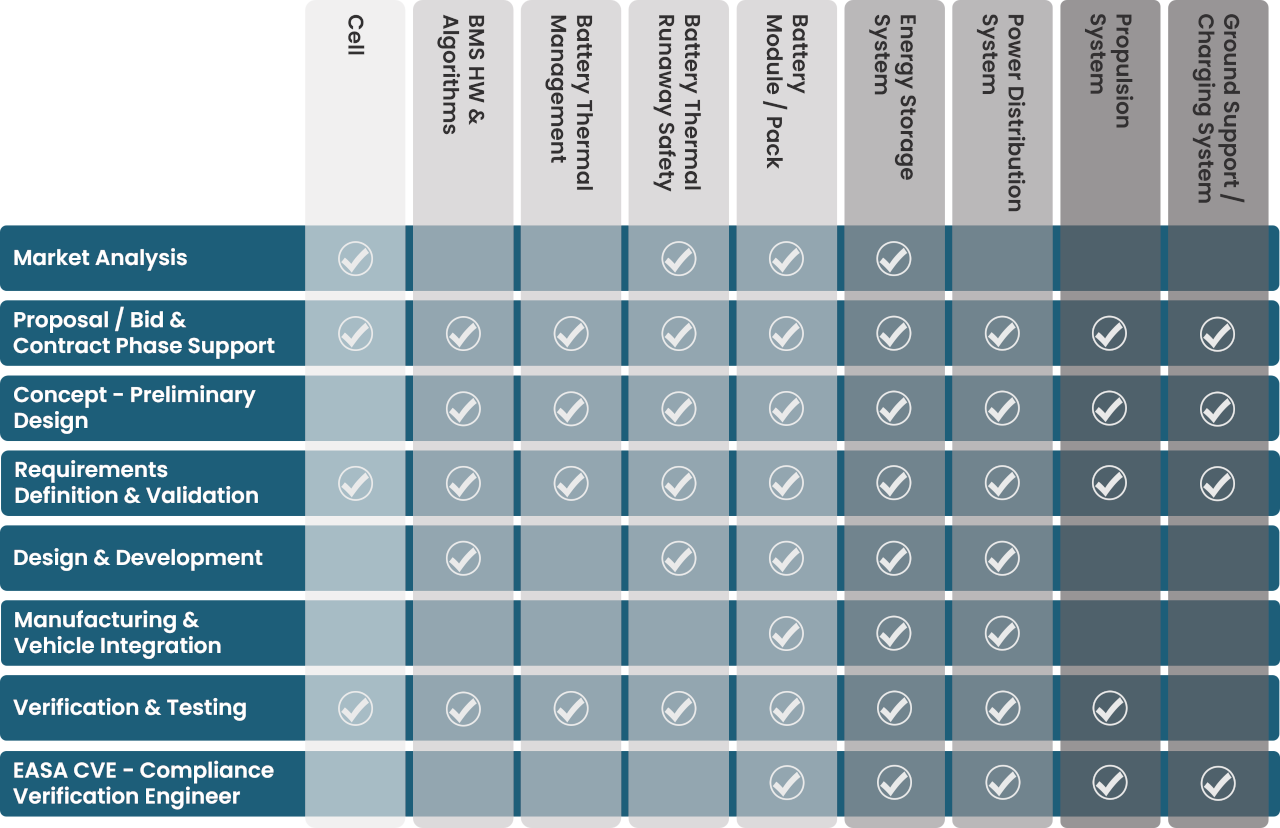
Authority-facing certification support
Electrivertic brings direct, 7+ years experience aligning on these topics with technical and policy experts in EASA and FAA projects, for both battery systems and electric motors / engines.
Support can be provided as independent subject-matter expert, certification engineer or Compliance Verification Engineer (CVE), depending on project structure, required independence and organisational appointment in a DOA.
Authority alignment since before guidance material was published
Started direct EASA Panel 5 discussions on propulsion battery certification topics in 2019, before key guidance material and Means of Compliance were available. Started EASA Panel 19 discussions on electric motor / engine certification topics in 2021.
Understanding authority expectations
Practical insight into what authorities expect to see, where requirements are implied rather than explicit, where negotiation is realistic and where technical or certification red lines are likely.
System-specific certification strategy
Development and authority alignment of certification plans, compliance checklists, Means / Methods of Compliance, design data and certification-relevant artifacts for novel electric and hybrid-electric propulsion systems.
Most effective when requirements are still evolving, Means of Compliance are not settled, or early architecture choices determine whether compliance demonstration remains realistic.
Why electrivertic
Get in touch
Let's discuss how to support your project
Aerospace electric propulsion experience
- Volocopter: continued supporting as external EPS CVE consultant after leaving as a full-time employee
- CS-23 / SC-E19 (EASA propulsion system TC): CVE electric engine and battery system
- eVTOL OEM (US FAA Powered-Lift project): Battery certification engineer, certification plan and compliance checklist support
- eVTOL OEM (JCAB project): Architectural, technical and regulatory assessment support
- eVTOL OEM (European project): Early stage involvement, hybrid-electric propulsion system architectural and certification strategy support
- FAR-27 OEM (TCCA project): Certification strategy and means of compliance for hybrid-electric propulsion system retrofit
- Cargo drone OEMs (European and Asian projects): Battery system and BMS detailed requirements, supplier assessments
Case Study
Volocopter eVTOL battery development
Technical leadership and responsibility for the in-house development of the first EASA-certifiable aviation propulsion battery system for SC-VTOL category “enhanced” from blank slate up to SOF for piloted flights
Cell selection
Role: Technical assessment & selection responsibility
E/E architecture
Role: Concept developemnt & technical leadership
Tradeoff studies
Role: Model development & analysis responsibility
Interface management
Role: Concept development & technical responsibility
Thermal Runaway - Fire safety
Role: Detailed development & technical responsibility
Thermal management
Role: Concept development incl. simulation & technical leadership
Weight
Role: Concept development & technical responsibility
Testing
Role: Technical leadership & responsibility
Manufacturing
Role: Technical leadership
Certification
Role: Leadership & responsibility (CVE)
Case Study
Electric propulsion system certification for CS-23 aircraft
Supporting the certification of the first SC E-19 electric propulsion system (combined battery and electric engine) TC for a CS-23 Level 1 aircraft as CVE for electrical motor and battery system in the H55 EASA DOA.
Electric Motor
- Create the Compliance Checklist and find agreement with EASA
- Complete overhaul of CCL due to change of the certification basis from SC E-18 to SC E-19, incl. corresponding impact assessments
- Support motor redesign activities to comply with critical parts requirements
- Enable use of non-aerospace motor supplier
- Participation in EUROCAE WG113 developing standards for endurance & durability testing
- Definition of corresponding test procedures and alignment with EASA Panel 19
- Review of qualification test plans
- Support for PDR, CDR milestones
Battery System
- Supported as SME and certification engineer before being nominated as CVE
- Complete overhaul of CCL due to change of the certification basis from SC E-22 to SC E-19, incl. corresponding impact assessments
- Supported PDR, CDR, TRR item and system level milestones
- Authoring and review of qualification test procedures
- Formal CVE witnessing of certification tests (conformity inspection of test article and setup, witnessing of test execution)
- Review of test reports
- Support with EASA discussions
- Review of changes, deviations and issues with the development teams and in the Change Board
Earlier battery
development
background
Project goal: Develop proof-of-concept for highest volumetric power density chassis-integrated 800V battery modules with 18600 cylindrical cells (in 2018)
Role: Project manager & technical lead
- Work with cell manufacturer to qualify cell for usage outside the nominal operating range to cover power peaks
- Create a unique lighweight top+bottom cooling plate solution for highly efficient cooling from cell poles
- Design single battery module for horizontal or vertical stacking
- Develop novel copper-based laser-welded cell connection scheme to handle high currents and double as thermal interface to cooling plates
- Verified cylindrical pack level specs: 156 Wh/kg – 295 Wh/l; 1500 W/kg – 2800 W/l continuous; 2600 W/kg – 4850 W/l for 30s
Project goal: Lead 12 industry and academia partners in the development of a lightweight city EV with swappable battery system
Role: Project coordinator
- General project coordination and results responsibility
- Technical focus on in-house battery system development (swap concept, assessment of required functionalities, requirements and BMS / electrical power distribution system architecture definiton)
- Support testing and vehicle integration of battery system
Project goal: Develop a functionally safe BMS for industrial and off-road applications without safety-critical software, and optimize SOx and balancing functions
Role: Technical expert & simulation tool developer
- Separate safety functions in simple HW from “comfort” functions in SW
- Define required functionality in “comfort” and “safety” subsystems
- Select components for HW-based safety monitoring and actuation, from ASICs to low-level transistor and gate logic
- Perform design reviews, safety assessments, FMEAs, troubleshooting / RCAs
- Develop flexible cell-level battery simulation tool in MATLAB to investigate and optimize SOx and balancing algorithms
Project goal: Assess, verify and deploy laser welding for cylindrical battery pack production
Role: Project manager
- Evaluate laser welding, wire bonding and laser bonding as alternatives to resistance welding and prepare management decision
- Work with equipment manufacturer and pack customers to define requirements for laser welding equipment
- Run and evaluate trials
- Support SOP
About
Dr.-Ing. Kyriakos Georgiadis, MBA is an interdisciplinary engineer, electric propulsion certification expert and former Volocopter battery development lead with more than 10 years of experience in high-performance battery systems, electric propulsion architectures and aerospace certification.

- Dr.-Ing. in Production Engineering, RWTH Aachen University
- MBA in Economics and Business Administration, RWTH Aachen University
- Dipl.-Ing. in Electrical and Computer Engineering, Aristotle University Thessaloniki
- 3 years of electric propulsion certification consulting experience working for a number of private and publicly listed eVTOL, aircraft and UAV OEMs
- 2 years as Head of Battery Development, 1 year as Electric Propulsion System Architect and 2 years as Electric Propulsion System CVE at Volocopter, an eVTOL pioneer
- 10 years of experience in engineering and battery development roles in non-aviation development and industrial manufacturing sectors
- Member and contributor in ASTM, EUROCAE and SAE
Frequently Asked Questions
Contact
Call
+49 1515 424 7781
Location
Karlsruhe, Germany
Disclosures in accordance with § 5 TMG
Electrivertic Battery Consulting – Kyriakos Georgiadis
Grötzinger Str. 42, 76227 Karlsruhe, Germany
Telephone: +49 1515 424 7781
E-Mail: [email protected]
Website: https://www.electrivertic.com
VAT ID number in accordance with § 27a UStG: DE362653842
This legal notice is also valid for the following social media profiles:
https://www.linkedin.com/company/electrivertic
https://www.linkedin.com/in/kyriakosgeorgiadis
https://www.xing.com/profile/Kyriakos_Georgiadis
Disclaimer
This website does not use cookies or user tracking tools and can be used without providing personal data. See also the privacy policy.
The author reserves the right not to be responsible for the topicality, correctness, completeness or quality of the information provided.
The author is not responsible for any contents linked or referred to from his pages.
The author intended not to use any copyrighted material for the publication or, if not possible, to indicate the copyright of the respective object. The copyright for any material created by the author is reserved. Any duplication or use of objects such as images, diagrams, or texts in other electronic or printed publications is not permitted without the author’s agreement.
The usage of the contact information for unsolicited communication, information or advertisement materials is prohibited.
Name and contact data of the data controller
Electrivertic – Kyriakos Georgiadis
Grötzinger Str. 42, 76227 Karlsruhe, Germany
Telephone: +49 1515 424 7781
E-Mail: [email protected]
Website: https://www.electrivertic.com
Processing personal data and purposes of processing when visiting the website:
You may access this website without having to disclose any details of your identity. To provide the website, we use storage, computing power and software which we rent or otherwise obtain from a server provider (webhost). We use a “Content-Delivery-Network” (CDN) to improve service quality and reliability. What the browser on your terminal device does automatically is only to send information to the server of our website (e.g. browser type and version, date and time of access) so as to allow a connection with the website. This also includes the IP address of your requesting terminal device. It is temporarily stored in a so-called log file and automatically deleted after 1 day.
The IP address is processed for technical and administrative purposes regarding connection set-up and stability, to guarantee the security and functioning of our website and to be able to track any illegal attacks on the website, if required.
The legal basis for processing the IP address is the first sentence of point (f) of Article 6(1) GDPR. Our legitimate interest ensues from said security interest and the necessity of the unobstructed availability of our website.
We cannot draw any direct conclusions about your identity from processing the IP address and other information in the log file.
Your Rights:
Pursuant to Article 7(3) GDPR, you have the right to withdraw the consent given to us at any time.
Pursuant to Article 15 GDPR, you have the right to obtain information about your personal data processed by us.
Pursuant to Article 16 GDPR, you have the right to obtain the rectification of inaccurate personal data without undue delay or the completion of your personal data stored with us.
Pursuant to Article 17 GDPR, you have the right to obtain the erasure of your personal data stored with us unless processing is necessary to exercise the right to freedom of expression and information, for compliance with a legal obligation , for reasons of public interest, or to establish, exercise or defend legal claims.
Pursuant to Article 18 GDPR, you have the right to obtain the restriction of the processing of your personal data.
Pursuant to Article 20 GDPR, you have the right to receive your personal data that you have provided to us, in a structured, commonly used and machine-readable format or to obtain the transmission to another data controller.
Pursuant to Article 77 GDPR, you have the right to lodge a complaint with a supervisory authority.
Pursuant to Article 21 GDPR, you have the right to object at any time to processing of your personal data, which is based on point (e) of Article 6(1) GDPR and on point (f) of Article 6(1) GDPR.